
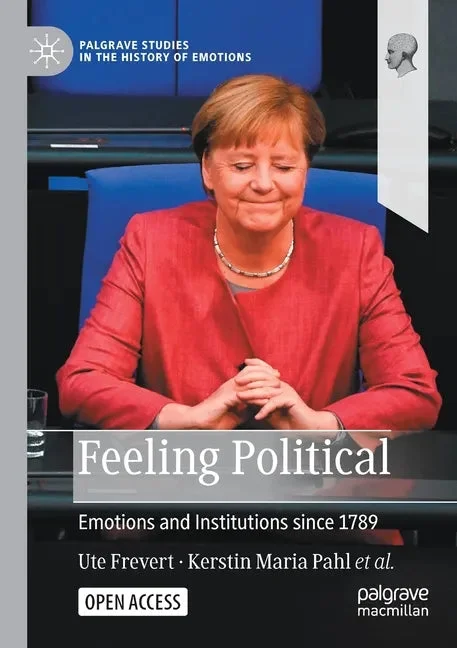
Description
by
Ute Frevert (Author),
Kerstin Maria Pahl (Author),
Francesco Buscemi (Author)
1. Introduction: Participatory Politics, Institutions, and Emotional Templating- Ute Frevert and Kerstin Maria Pahl
2. Feeling Political in Public Administration: French Bureaucracy between Militancy and sens de l’État, 1789-2019- Francesco Buscemi
3. Feeling Political in Parliament: Rules, Regulations, and the Rostrum, Germany 1849-1951- Philipp Nielsen
4. Feeling Political through Law: The Emergence of an International Criminal Jurisdiction, 1899-2019- Agnes Arndt
5. Feeling Political through Pictures: Portrayals of US Presidents, 1796-2020- Kerstin Maria Pahl
6. Feeling Political through the Radio: President Roosevelt’s Fire Side Chats, 1933-1944Michael Amico
7. Feeling Political on Armistice Day: Institutional Struggles in Interwar France- Karsten Lichau
8. Feeling Political in Military Cemeteries: Commemoration Politics in Fascist Italy- Hannah Malone
9. Feeling Political through a Football Club: FC Schalke 04, 1904-2020- Julia Wambach
10. Feeling Political by Collective Singing: Political Youth Organizations in Germany, 1920s-1960s- Juliane Brauer
11. Feeling Political across Borders: International Solidarity Movements, 1820s-1980s- Caroline Moine
12. Feeling Political in Demonstrations: Street Politics in Germany, 1832-2018- Ute Frevert
Back Jacket
Historicizing both emotions and politics, this open access book argues that the historical work of emotion is most clearly understood in terms of the dynamics of institutionalization. This is shown in twelve case studies that focus on decisive moments in European and US history from 1800 until today. Each case study clarifies how emotions were central to people’s political engagement and its effects. The sources range from parliamentary buildings and social movements, to images and speeches of presidents, from fascist cemeteries to the International Criminal Court. Both the timeframe and the geographical focus have been chosen to highlight the increasingly participatory character of nineteenth- and twentieth-century politics, which is inconceivable without the work of emotions.
Author Biography
Ute Frevert, Max Planck Institute for Human Development, Berlin, Germany
Kerstin Maria Pahl, Max Planck Institute for Human Development, Berlin, Germany
Francesco Buscemi, University of Groningen, Groningen, the Netherlands
Philipp Nielsen, Sarah Lawrence College, Bronxville, USA
Agnes Arndt, Max Planck Institute for Human Development, Berlin, Germany
Michael Amico, Max Planck Institute for Human Development, Berlin, Germany
Karsten Lichau, Max Planck Institute for Human Development, Berlin, Germany
Hannah Malone, Max Planck Institute for Human Development, Berlin, Germany
Julia Wambach, Max Planck Institute for Human Development, Berlin, Germany
Juliane Brauer, Bergische Universität Wuppertal, Germany
Caroline Moine, Max Planck Institute for Human Development, Berlin, Germany, and the Université Paris-Saclay, Gif-sur-Yvette, France
Number of Pages: 390Dimensions: 0.84 x 8.27 x 5.83 INIllustrated: YesPublication Date: April 07, 2022



Reviews
There are no reviews yet.